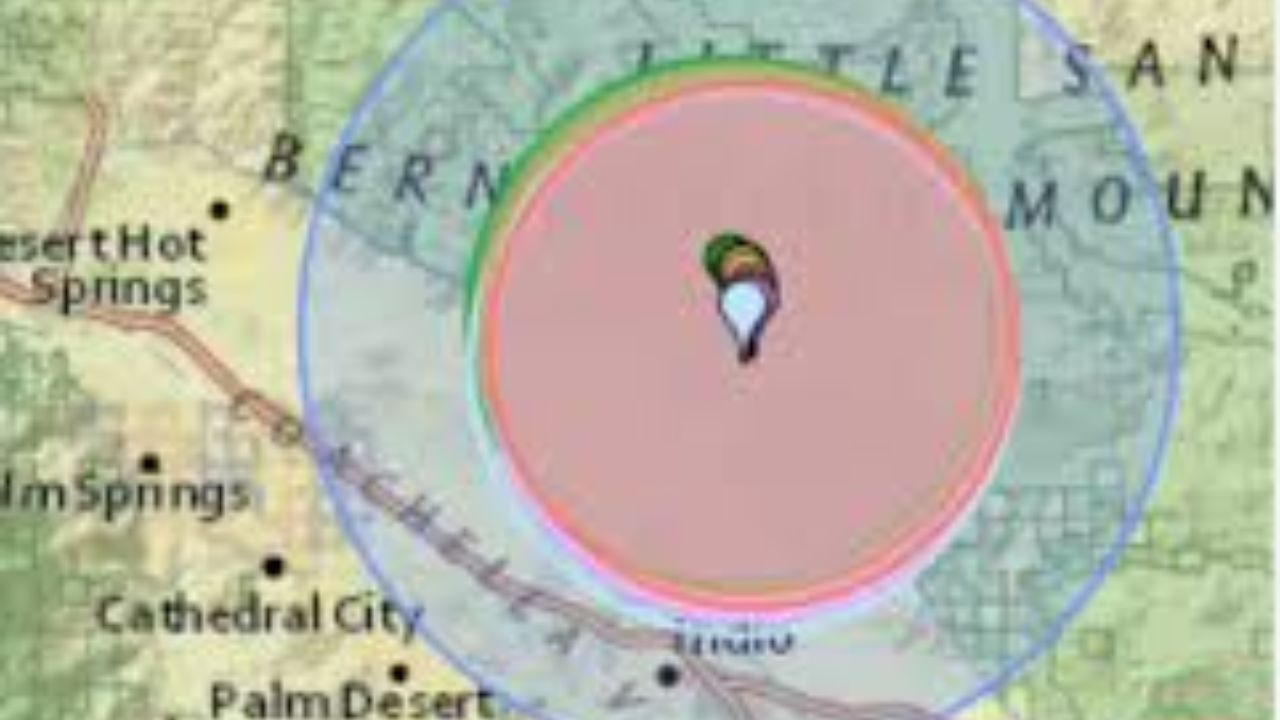
Southern California – A magnitude 4.9 earthquake rattled parts of Southern California on Jan. 19, according to the U.S. Geological Survey. The quake struck at approximately 5:56 p.m. PT about 12 miles northeast of Indio, causing noticeable shaking across the Coachella Valley, roughly 130 miles east of Los Angeles.
Strong Shaking Felt Across the Coachella Valley
Residents across multiple cities in the Coachella Valley reported strong shaking shortly after the quake hit. The USGS estimated the earthquake occurred at a shallow depth of about 1.8 miles beneath the surface, a factor that often contributes to more intense ground movement.
As of 6:30 p.m., seismologists had recorded at least 17 aftershocks linked to the initial earthquake. Two of the strongest aftershocks registered magnitudes of 3.4 and 3.3, indicating continued seismic activity in the area.
No Immediate Reports of Damage or Injuries
Authorities across the region said there were no early signs of serious damage. A spokesperson for the Palm Springs Police Department confirmed that the city had not received reports of damage or injuries following the quake.
Similarly, Indio officials said emergency crews found no immediate issues. City spokesperson Jessica Mediano stated there were “no reports of injuries and no immediate reports of any visible road damage.” Other nearby cities in the Coachella Valley also reported no significant impacts during initial assessments.
What to Do During an Earthquake
Emergency officials emphasize that safety steps depend on your location at the time of shaking, following guidance from Ready.gov.
If you are in bed, turn face down and cover your head and neck with a pillow.
If you are outdoors, remain outside and stay away from buildings, streetlights, and utility wires.
If you are indoors, stay where you are. Avoid doorways and do not run outside.
In all indoor situations, experts advise dropping to your hands and knees, covering your head and neck with your arms, and taking shelter under a sturdy table or desk. If no furniture is available, move next to an interior wall away from windows. Hold onto shelter so you can move with it if it shifts.
What If You’re Driving During an Earthquake?
The California Highway Patrol advises drivers to slow down and pull over when it is safe to do so. Drivers should remain in their vehicles with seat belts fastened, turn off the engine, and set the parking brake.
Once the shaking stops, occupants should check for injuries and vehicle damage. Driving should resume only when conditions are safe, avoiding bridges, ramps, or roadways that appear damaged or obstructed.
Why Earthquakes Occur
According to the USGS, earthquakes happen due to movement within the Earth’s lithosphere, which consists of tectonic plates forming the crust and upper mantle. These plates slowly shift and grind against one another. Stress builds up along cracks known as faults, and when that stress is suddenly released, seismic waves are generated, resulting in an earthquake.
Because earthquake magnitude is measured on a logarithmic scale, a magnitude 4.9 quake is significantly stronger than quakes below magnitude 4. Each whole-number increase represents a tenfold increase in measured ground motion.
California’s Largest Recorded Earthquakes
California has experienced some of the most powerful earthquakes in U.S. history. Among the largest recorded since 1800 are the 7.9 Fort Tejon earthquake in 1857, the devastating 7.8 San Francisco quake in 1906, and the 7.3 Landers earthquake in 1992, which injured hundreds.
Can the Next Earthquake Be Predicted?
Scientists stress that earthquakes cannot be predicted. While the USGS can estimate the probability of future seismic activity over long periods, these forecasts are comparable to climate or weather probabilities, not precise predictions.
USGS maps show that large portions of California have more than a 95% chance of experiencing noticeable earthquake shaking within the next 100 years. Experts also continue to dispel myths that California could break off into the ocean, noting that earthquakes cause horizontal movement over millions of years, not sudden land collapse.